Cap rates are tighter, operating costs are up, and the Renters' Rights Act has added compliance weight to every decision. The financial performance institutional capital underwrote at acquisition is now won at the operational layer. And nowhere is more value at stake than in the final ninety days of a tenancy.

Consider what actually happens in that window. A rent review is served. A resident decides to renew, negotiate, or leave. A notice period either becomes a marketing head-start or dead time. A void either lasts two days or three weeks. A re-let either captures the market or resets below it. Every one of those moments moves NOI.
Yet in most portfolios, this critical window is run as a relay race between disconnected systems: the rent review in a spreadsheet, the negotiation in an inbox, the notice in the PMS, the marketing handover in a weekly call, the void report landing a month after the void began. The decisions that matter most are made latest, on the least data, by the most stretched teams.
Yield Control exists to change that.
Yield Control is a collection of automations, workflows, and reporting tools that simplify and streamline the end-of-tenancy process and align agents, managers, and owners to achieve better outcomes earlier.
It is not another point solution bolted onto the stack. It is the orchestration layer of our rental operating system, pointed at the most expensive weeks of every tenancy. It turns the rent review, the renewal decision, the notice period, and the re-let from a sequence of handovers into one continuous, visible, partly automated process, with every stakeholder working from the same live picture.
Because here is the truth the monthly pack hides: the tenancy lifecycle is a loop, not a line. Community leads to rent review, rent review to decision, decision to marketing, marketing to leasing, and leasing back to community. Every property in your portfolio is always somewhere on that loop. The earlier on the loop you act, the cheaper the intervention. A retention gesture in month eight costs a voucher. The same problem discovered when notice lands costs a void, a refurb, and a re-let fee.
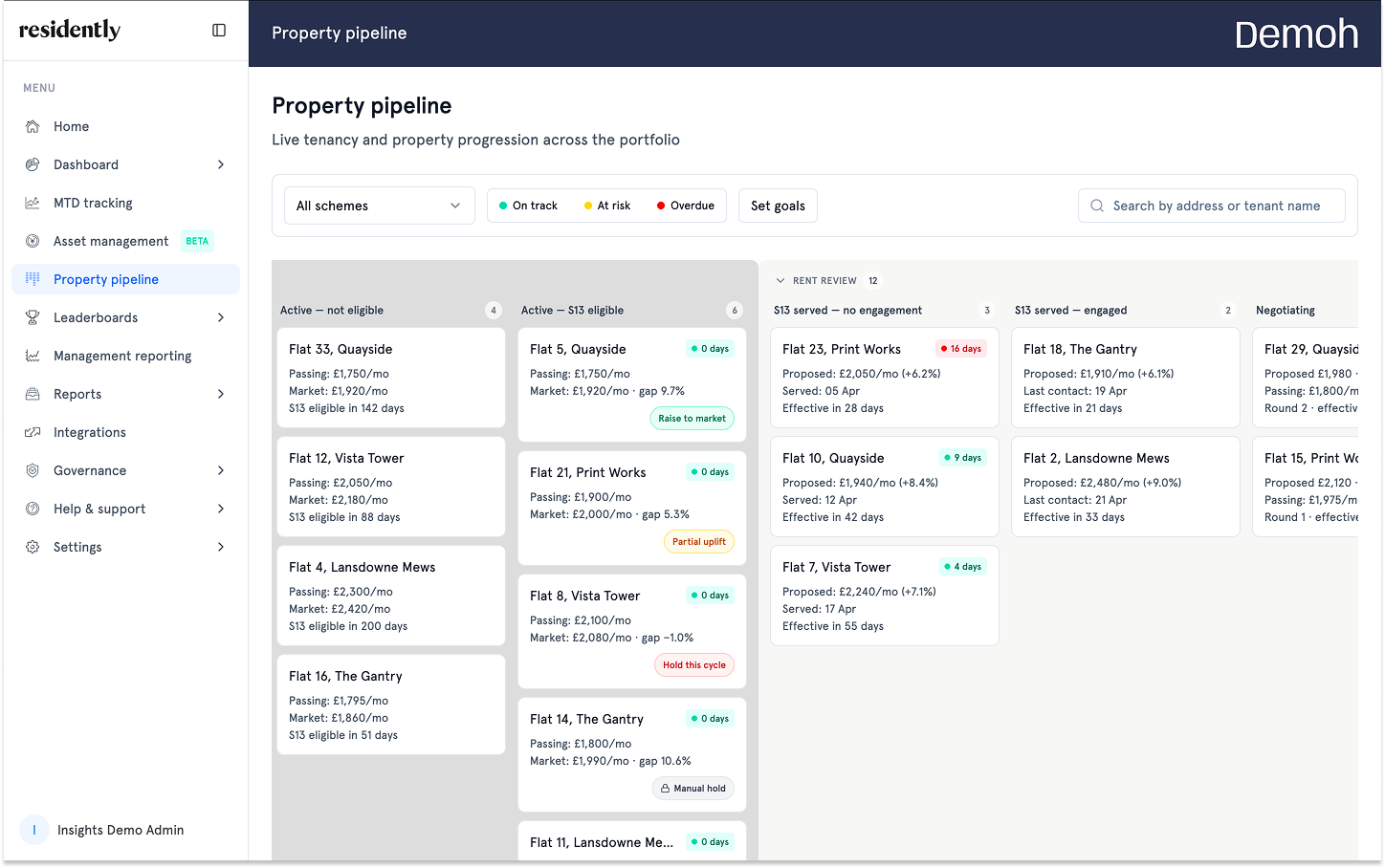
It sees the whole picture before you decide. Yield Control brings market intelligence — demand metrics, competitor pricing, localised trends — together with everything you know about the property and the resident: sentiment and engagement, communication history, maintenance record, payment behaviour, affordability. One view, per tenancy, at the moment a decision is due. If you can't see it, you can't manage it; if you can't manage it, you're losing yield to it.
It spots the leaver before the notice arrives. Predictive analysis reads the signals residents give off long before they hand in notice — declining satisfaction scores, unresolved maintenance friction, fading engagement, payment timing drifting, a widening gap to market. At-risk tenancies are flagged with the drivers named and an intervention recommended, while retention is still cheap.
It prices fairly, and can prove it. Traditional revenue management leans on broad averages or fixed percentage uplifts. Yield Control makes nuanced, evidenced judgements — weighing real market conditions against the individual resident relationship, and making the trade-off explicit: full uplift with a lower renewal probability, or partial uplift with a stronger one. Every recommendation can show its reasoning, which matters when the destination might be a negotiation, a tribunal, or an investment committee. Fair pricing is not a slogan; it is pricing with evidence attached. From there, personalised rent reviews are drafted from the live record — correct form, right dates, comparables cited — approved by your team and served with a full audit trail.
It runs your process, not ours. The property pipeline tracks every unit from marketing through to the end-of-tenancy decision — and with Yield Control, the stages are yours to define. Partners configure the steps, SLAs, approval gates, and language of each phase around their own asset management strategy, whether that is a refurb-heavy single-family portfolio, a high-amenity multi-family scheme, or a rebooking-driven student cycle. Centralised standards, decentralised execution: the hub-and-spoke model, applied to the tenancy lifecycle itself. Underneath, a common data model keeps every metric comparable, so customisation never comes at the cost of benchmarking.
It turns intent into tasks. Workflows generate the work automatically: tasks created as properties enter each stage, assigned to the right people, prioritised by the money at stake. A £2,400-a-month void outranks a £1,750 one, and the system knows it. Approvals route to the right desk — an uplift above threshold to the asset manager, a disposal to the owner — so alignment happens in the platform, not over email.
It aligns incentives, including the resident's. Small, well-timed incentives — a voucher, a free end-of-tenancy clean, a week's rent — have let our clients secure early access for viewings during notice periods and re-let properties on a resident's referral without a single viewing. Yield Control productises these plays, alongside refer-a-friend and cross-sell campaigns and AI-assisted property inspections, and tracks the return on every pound of incentive spent against the void days it avoided.
It proves the outcome. Across the journey, Insights+ reports what happened and what it was worth: SLAs hit by stage and team, tasks managed, risks flagged and averted, rent review conversion, uplift achieved versus market, void days avoided. Operational discipline, translated into the language of NOI and asset value — in real time, not in next month's pack.
.png)
Anyone can promise smarter pricing or predictive retention. Very few can deliver it, for a simple reason: these capabilities are only as good as the data underneath them, and the data underneath most portfolios is fragmented across a patchwork of point solutions that were never designed to talk to each other. Bolting intelligence onto that foundation automates the chaos rather than removing it.
Residently built the foundation first. Our rental operating system runs marketing, leasing, and community in one place. That means the signals Yield Control depends on—sentiment, engagement, maintenance history, payment behaviour, market performance—are already captured, structured, and consistent, because they are generated inside one system rather than reconciled between five. Our architecture is resident-first, not property-first: the master record is built around the person making the renewal decision, which is precisely the record you need when the question is "will they stay, and at what price?"
And the automation muscle is already proven in production. Our platform saves teams 7+ hours of admin per tenancy, completes around 90% of applications without human intervention, and achieves 90% resident app adoption — the engagement channel every retention play depends on. Yield Control is not a leap into the unknown; it is the next layer on infrastructure that is already doing the heavy lifting every day.
We sit above your PMS, not in place of it. Your accounting backbone stays. What changes is that the front end of the business, where experience is delivered, decisions are made, and yield is defended, finally runs on one connected system, with property teams, asset managers, and owners seeing the same truth at the same time.
The maths is the argument. A controllable void week across 5,000 units at £1,500 per month is £1.5m of recoverable rent — £30–37m of asset value at current cap rates. Compress controllable voids by up to 30%, capture the uplift the market supports while keeping the residents worth keeping, save £1,000 a let by running the process in-house, and defend a premium through a five-star resident experience. The compounding effect across a portfolio is measured in basis points of yield and millions of asset value.
Longer stays. Shorter voids. Boosted NOI. That is Yield Control. Decisions made earlier, on better data, executed in one place, and proven in the numbers your investors read.
If you would like to see Yield Control against your own portfolio, our team will run your numbers through the NOI model and show you what the end of the tenancy is currently costing you. Get in touch to book a walkthrough.