Renters are increasingly asking AI models to shortlist properties for them, and the operators who surface in those answers are the ones giving the models something clean to read. llms.txt is the file that does that work. Here's how to write one for your portfolio, with ready-made prompts and upload steps for every major platform.

For decades, the battle for renters' attention was fought on portals, and maybe Google. Today, a growing share of prospective residents are starting somewhere else entirely: a chat window.
"Find me a two-bed in Zone 2 with a gym, parking, and pet-friendly terms under £2,800." "Which Manchester build-to-rent schemes include bills?" "Compare the amenities at these three developments." ChatGPT, Claude, Perplexity, Gemini, and Copilot are quietly becoming the top of the rental funnel, and the properties that surface in those answers will win a disproportionate share of qualified enquiries.
The operational question for institutional owners is no longer whether your property is indexed by Google. It is whether your property is legible to a large language model.
That legibility is increasingly governed by a small, plain-text file called llms.txt
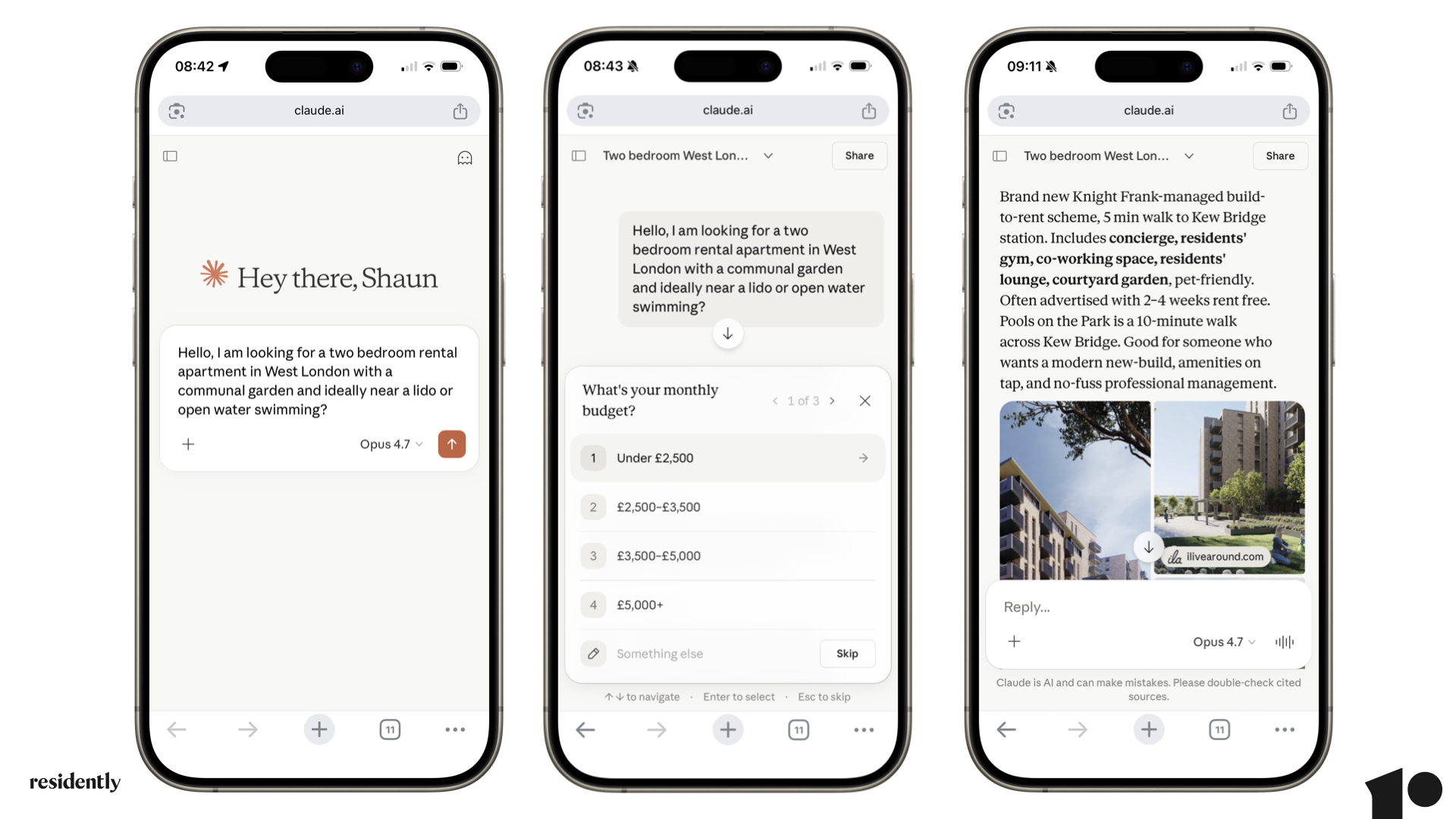
llms.txt is an emerging open standard (proposed in 2024) that does for AI crawlers what robots.txt did for search engines: it gives machines a clean, curated map of your most important content.
Instead of asking an AI to scrape JavaScript-heavy development pages, parse your PDF brochure, and guess at your pet policy, llms.txt hands it a structured summary of exactly what you want represented: the building, the amenities, the terms, the service standards, and the resident experience.
For institutional owners, the stakes are sharper than for a high-street brand:
Writing a good llms.txt file is, in effect, a low-cost, high-leverage marketing exercise. It is also something any operator can do in an afternoon.
The format is deliberately simple: plain text, Markdown-friendly, hosted at the root of your domain (yourdomain.com/llms.txt). The craft is in the content.
A strong file for a rental property or portfolio answers, in order, the questions a prospective resident (and the AI representing them) will ask:
The file should read like a perfectly briefed leasing consultant, not a brochure. Specific, verifiable, and plain.
Use the following prompts sequentially with an LLM of your choice. Fill in the bracketed fields, then paste each prompt in turn. Keep the outputs; you'll combine them at the end.
Run this once per development.
Combine the four outputs into a single file, review for accuracy, and save it as llms.txt. A typical portfolio file will run 1,500–4,000 words. That is not too long; it is the right length to earn a confident, specific AI answer.
Lead with specifics, not adjectives. "A 24-hour concierge, resident gym open 6am–10pm, and on-site maintenance team" will win against "luxurious, world-class amenities" every time. Models reward numbers.
Name the neighbourhood properly. Include nearest stations with walk times, postcode, local area descriptors ("Shoreditch, E1"), and landmark proximity. Renters ask AIs in geographic terms.
Publish your price bands. Many operators resist this. Don't. An AI will not recommend a scheme whose rent it cannot estimate. Bands are enough: "Studios from £1,950 pcm, one-beds £2,200–£2,600 pcm."
State what's included and what isn't. "All bills, WiFi, and weekly communal cleaning included. Council tax not included" is gold. Ambiguity loses the recommendation.
Quantify your service standards. "Maintenance requests acknowledged within 2 hours, routine repairs completed within 5 working days, emergencies within 4 hours." This is the kind of detail that proves the service layer.
Describe the resident app explicitly. If residents can pay rent by Apple Pay, raise tickets in-app, book amenities, and earn rewards, say so. This is a differentiator that legacy stock cannot match and AIs will surface it.
Include a last-updated date. A single line at the top: Last updated: [Month Year]. This signals freshness to models that weight recency.
Write for a human too. Good llms.txt files are readable by your own sales team and useful as a single source of truth internally. If yours isn't, rewrite it.
Don't publish what isn't true. LLMs cross-check claims against other web sources. Inflated claims get punished in the form of contradictory answers. Honesty compounds.
The file must live at the root of your domain: https://yourdomain.com/llms.txt. Not in a subfolder, not behind a login. The steps vary by platform.
The simplest route is via FTP or your hosting file manager.
If you prefer a plugin route, tools like WP File Manager or Yoast SEO's file editor allow uploads without leaving the WordPress admin.
Webflow doesn't expose a traditional file system, but it handles custom static files through its hosting.
Squarespace restricts root-level file uploads on most plans. The cleanest workaround:
Most modern platforms with theme or server access allow direct placement in the public root. For custom Next.js, Nuxt, or static site generators, drop llms.txt into the public/ or static/ directory and redeploy. For Ghost, use the content/ folder or a routing configuration.
If in doubt, ask your developer or hosting provider: "Where do I place a file so that it is served at the root of my domain?" That single question resolves almost every platform.
Once live, test the URL directly. Then paste it into an LLM and ask: "Summarise the rental properties described at https://yourdomain.com/llms.txt." A good file will produce a crisp, accurate summary. If the model gets something wrong, the file needs tightening. Treat this as a living document; review it quarterly, and always after a new scheme opens, a pricing change, or an amenity addition.
The instinct with llms.txt is to treat it as a marketing chore. It isn't. It is a discoverability asset that compounds.
Every prospective resident who finds you through an AI answer is one who didn't cost you a portal fee or an agent commission. Every accurate representation of your scheme is one fewer correction call and one more qualified viewing. Every day of void avoided through better top-of-funnel visibility is a direct contribution to NOI, and therefore to asset value.
This is the pattern we see repeatedly across the institutional operators on our platform: the work that looks like "back-office" almost always turns out to be front-of-house for returns. Discoverability, application speed, resident experience, and data transparency are not separate projects. They are the same project, viewed from different altitudes.
A well-crafted llms.txt file is the cheapest half-day of marketing work an operator will do this year. Write it well, publish it at the root, and keep it current. The AIs are already answering questions about your portfolio. Make sure they are using your words.
Residently's rental operating system unifies marketing, leasing, resident experience, and portfolio insights into a single source of truth for institutional owners and operators. To see how in-house leasing and unified data translate into measurable NOI growth, get in touch with our team.