How the Renters' Rights Act turned pricing into a retention discipline — and what institutional owners should do about it

The Renters' Rights Act has quietly changed the unit economics of the rent review. Most institutional owners haven't repriced the risk yet.
Under the new regime, renters can refer any proposed rent increase to the First-tier Tribunal. The Tribunal then determines market rent. The new rent cannot exceed the owner's proposed amount, but it can be set lower, and it doesn't take effect until the determination is made.
For a single tenancy, that is a procedural change. For an institutional portfolio, it is a P&L event.
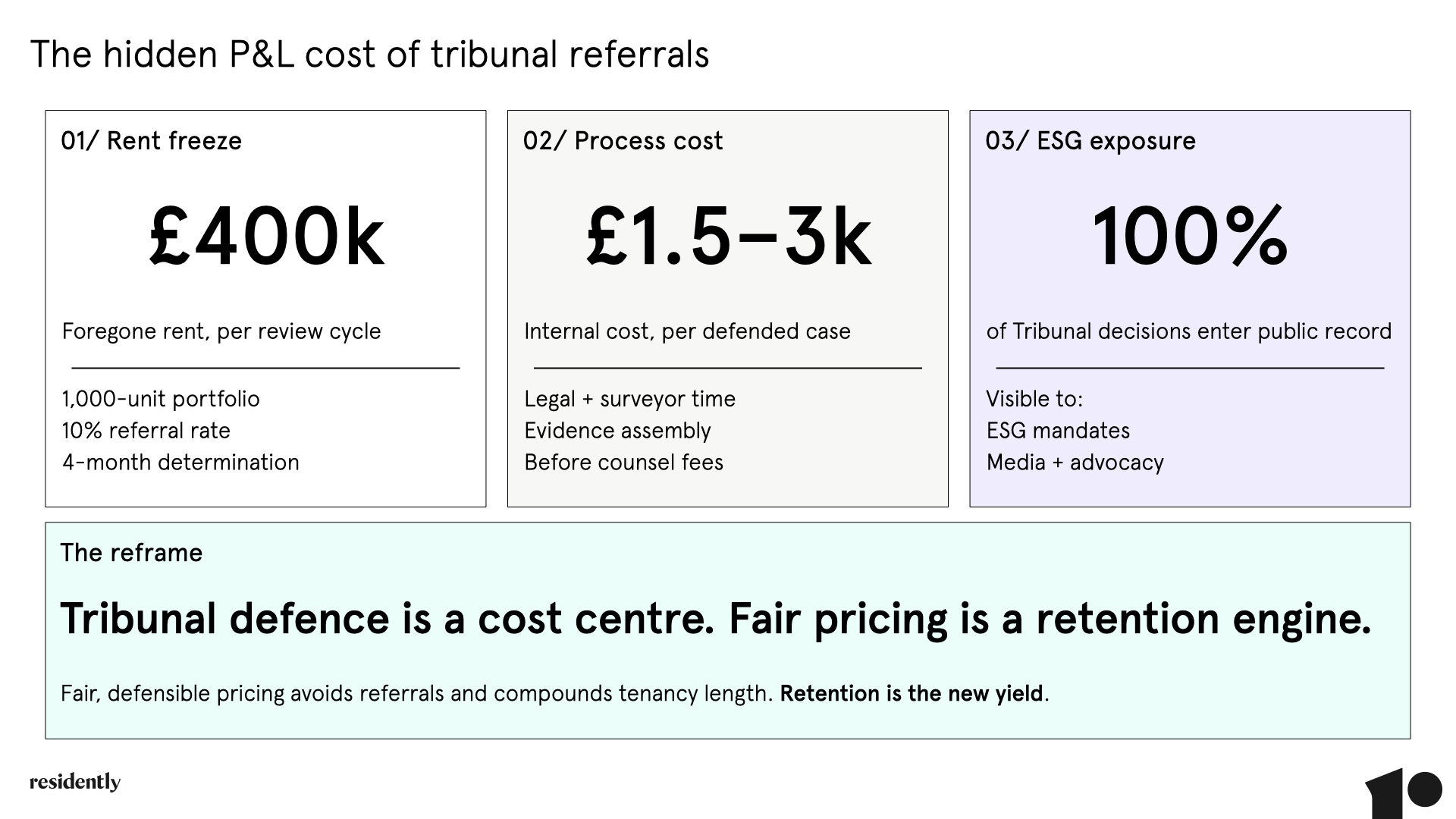
The cost of a referral isn't the £500 application fee. It's three pressures that stack on top of one another across a portfolio.
Rent freeze during referral. If 10% of renters in a 1,000-unit portfolio refer a £100/month increase, and the average referral takes four months to determine, that is £400,000 of foregone rent in a single review cycle — before factoring in unrecoverable arrears risk if the Tribunal upholds the increase but the resident cannot afford the catch-up. And referral isn't always a function of weak evidence: Goodlord's research suggests a meaningful share of renters will challenge regardless of how well an increase is justified.
Cost-of-process. Tribunal preparation, evidence assembly, internal legal and surveyor time. Industry estimates from BCLP and Mayer Brown put the fully loaded internal cost at £1,500–£3,000 per defended case, before external counsel. Multiply that across a review cycle, and the "back-office" line item becomes a material drag on net operating income.
Reputational and ESG drag. Lost Tribunal decisions are published. Patterns of losses — particularly where the Tribunal materially cuts proposed rents — feed directly into Generation Rent, Shelter, and journalist scrutiny. For pension-fund-backed BTR sponsors carrying ESG mandates, this is a live reputational exposure, not an abstract one.
Underneath all three sits a strategic shift most owners are still digesting.
Inventory data published by InventoryBase (April 2026) and the Deposit Protection Service (January 2026) shows average tenancy length is now 1,085 days — roughly three years — and rising. In a more fluid post-RRA environment, retention has quietly become the new yield. Pricing fairly, and being seen to price fairly, is now a retention lever, not just a margin lever.
So the instinct to staff up — more legal, more surveyors, more evidence — solves for the wrong moment. Tribunal defence is a cost centre. The higher-yielding play sits upstream of the referral entirely: price defensibly, deliver an experience worth renewing for, and the referral never happens.
That is a different operating model, not a different legal strategy. It has two parts.

Most rent reviews are still set from a desktop comparable and a spreadsheet. That produces two failure modes. Price too low and you leave yield on the table. Price too high without defensible evidence and you invite a referral you may lose — freezing the rent and publishing the loss.
A fairer, more defensible price needs two inputs working together.
The first is the market: live local comparables, so the proposed figure reflects what the asset can actually command today, not last year's assumption.
The second is the resident — and this is where most owners are flying blind. Our rental operating system assembles a 360-degree view of the tenancy before any renewal notice is drafted:
Bring these together, and the same dataset does two jobs at once. It guides a fairer price calibrated to the resident's real circumstances and the asset's real performance. And it flags, before you act, exactly where an increase is material to defensibility: a resident with a poor maintenance record, a falling NPS, and a verbatim complaint about slow repairs is a resident whose own file becomes evidence against you at Tribunal.
That is the shift in plain terms. The data that helps you price fairly is the same data that tells you which increases will survive a referral and which will freeze your rent and result in a loss.
Fair pricing keeps a resident at the table. An experience worth renewing for is what keeps them in the property.
The maintenance signals that make an increase indefensible — slow repairs, missed SLAs, a falling satisfaction score — are operational failures before they are pricing problems. Fix the operations, and you remove the cause, not just the symptom.
That is what the operating system is built to do. It takes the administrative drag off property managers so their time goes into service, not chasing. Every member of the team — manager, portfolio lead, asset owner — works from one source of truth, so nothing falls between disconnected tools. Maintenance tickets and requests are routed and resolved faster, closing the exact gaps that erode sentiment. And residents manage their entire stay — payments, repairs, documents, community — through a single, modern app that simply works.
The result is an experience worth renewing for, so the rent review becomes a conversation rather than a confrontation. Controllable voids fall. Tenancies lengthen. And the referral risk that started this whole problem quietly shrinks, because residents who feel fairly treated and well served rarely reach for the Tribunal in the first place.
This is where the strategic loop closes. At a 4–5% cap rate, every £1 of sustained NOI growth adds £20–25 in asset value. Retention protects that NOI more reliably than any defended rent increase — it eliminates void periods, removes re-let costs, and compounds across a three-year tenancy rather than resetting every twelve months.
The Renters' Rights Act didn't make rent reviews harder. It made operational excellence financially legible. The owners who come out of this cycle ahead won't be the ones with the best Tribunal lawyers. They'll be the ones who priced not to need one — and built an experience worth renewing for.
That is the conversation we're having with the institutional owners we work with right now: how to price defensibly under the RRA, how to build a Tribunal-ready evidence base, and how to turn operational performance into investment confidence. If it's the conversation happening inside your portfolio, we'd welcome it.