There is a line that keeps coming up in conversations, and it comes from Antony Slumbers, the global keynote speaker on AI in real estate: "Legacy real estate software slows AI down."

It is a deceptively simple statement, and it explains more about the current state of AI in our industry than any product demo ever will.
.png)
The institutional rental sector is under no illusion about the pressure it faces. Yield compression, capital scarcity and rising resident expectations have made operational performance the primary lever of returns. AI has been sold as the answer and budgets have followed.
The results have not. According to Gartner research, 70–85% of enterprise AI projects worldwide are failing to meet expectations. Fivetran's enterprise survey found that 42% of AI initiative failures are attributable specifically to data readiness, not model quality, not vendor selection, not budget. Data.
Slumbers has spent three decades at the intersection of real estate and technology, from launching the UK's first commercial property website to advising real estate boards on AI strategy. His core argument about the current AI wave is one of sequencing.
Most AI failures trace back to data. And it is not simply a question of quantity; it is quality. Is the data structured correctly? Is it resident-first? Can you trust it? Was it updated manually? Where did it come from? How old is it? If an operator cannot answer those questions with confidence, no AI tool (however sophisticated) will produce outputs their teams can act on.
The takeaway is that you cannot bolt AI tools onto a legacy tech stack and expect magic. Legacy systems were not built for the AI era. They rely on humans moving data from one part of the stack to another, and every manual handover degrades the quality of the data that eventually reaches your AI. In Slumbers' words, you need to fix the chassis before you buy the engine. The engine is AI: the models, the copilots, the automated agents. The chassis is everything underneath—the operational data, the workflows, the processes that generate the information AI depends on. Bolting a Formula 1 engine onto a chassis that was never engineered for it does not produce speed. It produces failure, expensively.
Here is why that is true mechanically.
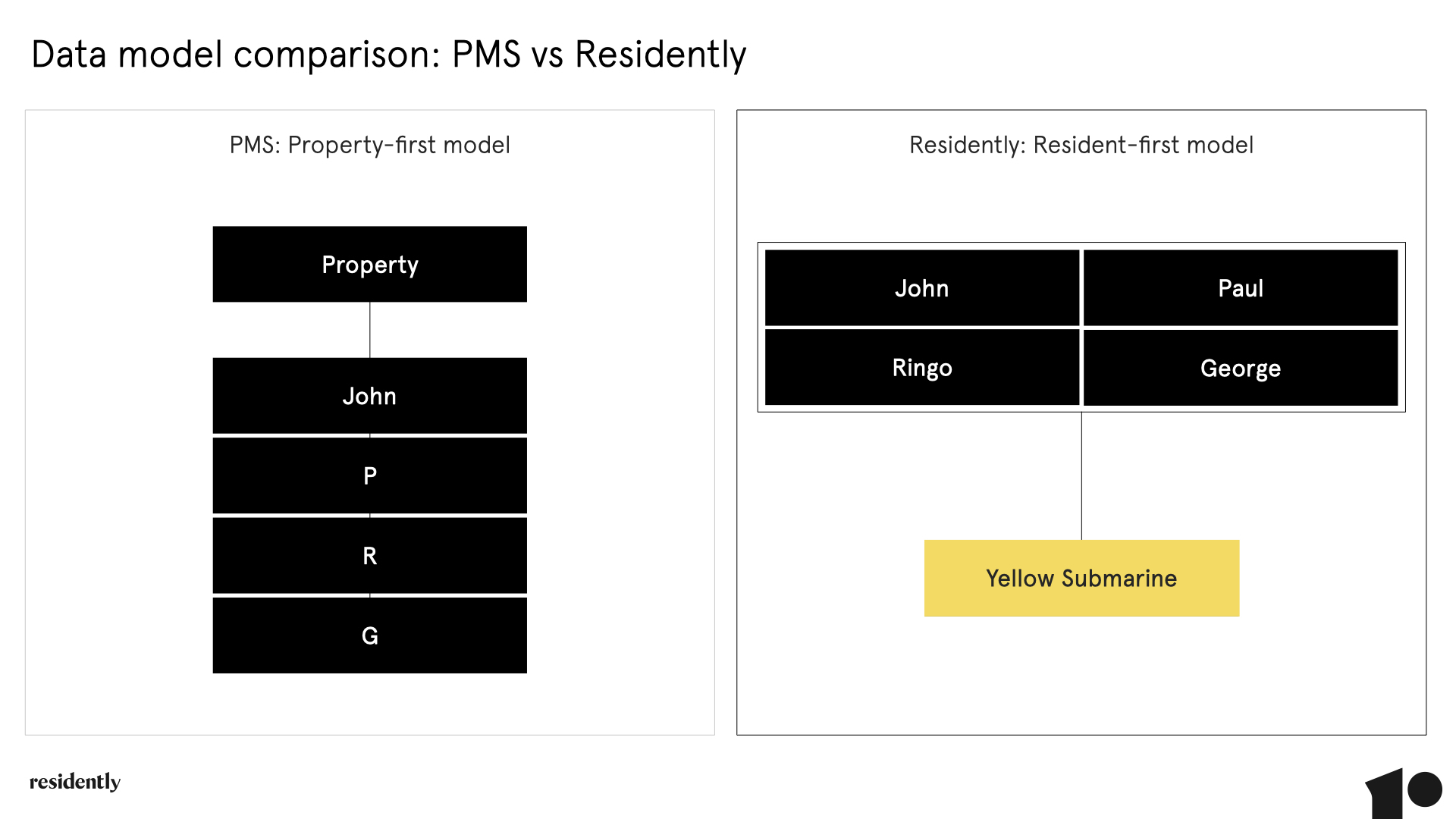
AI is only as good as the data you feed it, and most property data lives in a PMS built for accounting, not operations. The property is the primary record; the resident, the entity whose behaviour drives nearly every financial outcome, exists as a loose attachment to a property file. The result is data that is incomplete, inconsistently formatted, and trusted by no one: initials in name fields, four residents lumped into one record, contact details that decayed years ago.
Operators have tried to compensate by layering point solutions on top. A leasing tool here, a maintenance platform there, a comms suite somewhere else. Each solves a genuine need. Collectively, they fragment data at every handoff. Moving data between disconnected tools does not transfer it cleanly; it degrades it.
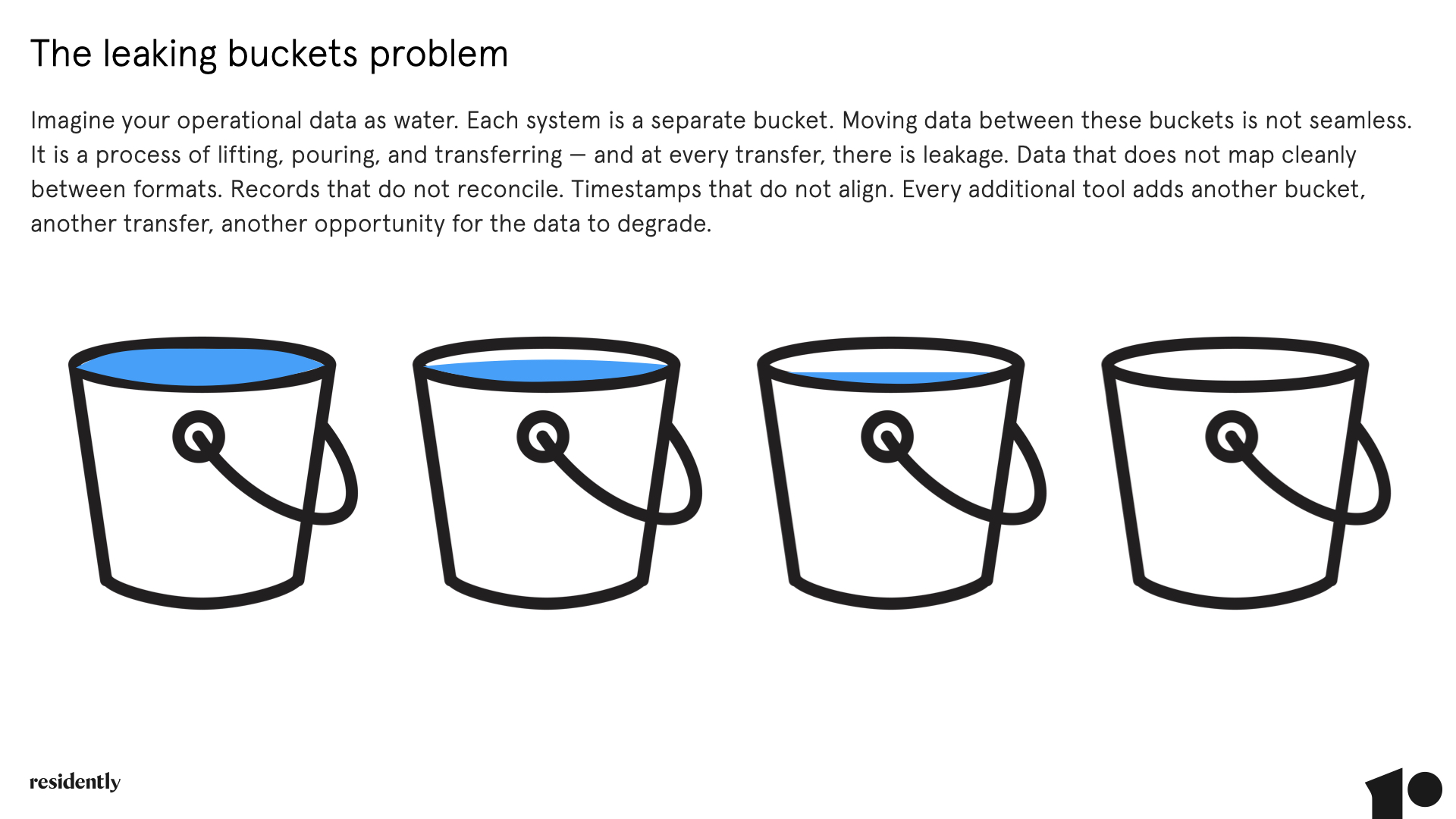
We call this the leaking buckets problem. Imagine your operational data as water, and each system as a separate bucket. Moving data between buckets is not seamless. It is lifting, pouring and transferring, and at every transfer there is leakage. Fields that do not map. Records that do not reconcile. Timestamps that do not align. Every additional tool adds another bucket, another transfer, another opportunity for degradation.
Feed a model this kind of data, and it produces confidently wrong results. AI hallucination is not a bug. It is what happens when a model fills gaps in incomplete data with confidence.
Dirty data, however, is a symptom. Undocumented workflows are the cause.
A workflow is the specification for how data gets created. When a maintenance request is logged, which fields are mandatory? When a lead is qualified, what criteria must be met before it progresses? If the answer is "it depends on who's doing it", no AI tool can reliably act on the output.
This is the point most AI vendors would prefer you not to dwell on: if a process varies by property manager, geography, or who is on shift, AI does not fix the inconsistency; it scales it. You cannot automate a process that was never properly defined. Automating an inconsistent process simply accelerates the inconsistency, at machine speed, across the whole portfolio.
There is a third failure mode that rarely appears in vendor pitch decks. Teams who have spent years compensating for unreliable systems do not suddenly trust AI outputs, and often they are right not to. They know the PMS holds duplicates. They know the leasing platform's void rate does not match the asset manager's spreadsheet. So they double-check everything, and the "automation" becomes a veneer over a workflow that still runs on email and spreadsheets.
Trust in AI is downstream of trust in data, and trust in data is downstream of trust in process. There is no shortcut through this chain. Rebuilding it means standardising the workflows that generate the data in the first place, so the numbers are trustworthy by design rather than cleaned after the fact.
Which brings us to the current wave of AI point solutions being marketed to property operators. Their pitch, stripped of the branding, is this: your tech stack is fragmented, so we will use AI to stitch it together.
But stitching together a fragmented stack does not replace it. These tools automate the chaos; they do not remove it. They inherit every leaking bucket, every undocumented workflow, every untrusted record, and then act on them faster. The question to ask any AI vendor is simple: what exactly are you automating, and how clean is the data underneath it?
There is also an economic clock ticking. Many AI tools are built on model providers currently subsidising usage costs from investor capital. When those costs are passed on, the tools built on top of them will get more expensive overnight, and the AI feature race will look a great deal less attractive. Operators locked into a patchwork of AI point solutions will be paying for someone else's experiment.
Fixing the chassis means unifying your operational data, replacing manual updates with documented, standardised workflows, and building something machines can use as fluently as people do. That is precisely the bet we have been making at Residently.
One connected system, one source of truth. Our rental operating system unifies marketing, leasing, tenancy progression and resident engagement in a single platform, so property managers, portfolio managers, asset owners and residents all work from the same real-time source of truth. No buckets. No leakage.
A resident-first data model. Our master record is the resident, not the property. Cleansed, enriched and synchronised across every workflow from day one. This is the golden record AI requires, being built as a by-product of normal operations.
Documented workflows as guardrails. Every workflow is structured, rules-based and consistent across every property, team and geography. The process cannot be followed differently in Manchester than in Birmingham. These are exactly the guardrails AI needs to function reliably.
Automation that already does the heavy lifting. We automate lead management, tenancy progression, communications, and chasers today (50 touchpoints across email, SMS, and push notifications). Around 90% of applications on our platform complete without human intervention, and operators save 7+ hours of admin per tenancy.
Insights+ for institutional-grade oversight. Operational data consolidated and translated into actionable performance insight, aligning day-to-day execution with fund-level KPIs, and replacing delayed, inconsistent reporting with transparent, real-time dashboards.
This is not infrastructure for its own sake. Operational excellence is the primary driver of NOI. And when AI matures, when the models are reliable enough, the costs sustainable, and the data underneath ready, operators on a unified foundation will be the ones with something worth feeding it. Apple did not build the first MP3 player, the first smartphone or the first smartwatch. It built the best ones, at the right moment, on the right foundation.
Fix the chassis first. The engine is coming, and it will only be as good as what it runs on.