The latest Knight Frank multifamily operational performance report contains a finding that should give every institutional owner pause. When asked how they source operational performance data across their portfolio, only 31% of respondents said they can self-serve from a single system. The majority — 44% — are stitching together information from multiple platforms. A further 25% can't access it themselves at all; they're dependent on a member of staff or a third-party operator to pull the numbers for them.
%201.png)
For portfolios worth hundreds of millions of pounds, this is a remarkable state of affairs.
This isn't a data shortage. Institutional rental portfolios generate vast amounts of operational data every single day — leads, viewings, applications, tenancy start dates, rent collections, maintenance requests, renewal decisions, void periods. The information is there.
The problem is where it lives, and what condition it's in by the time it reaches the people who need it most.
Legacy property management systems were built for accounting. They hold significant data, but it is frequently incomplete, incorrectly formatted, or simply not structured in a way that makes it usable for operational decision-making. Asset managers trying to extract meaningful performance metrics from a traditional PMS often find themselves working with numbers they can't fully trust.
Then there are the point solutions — the specialist tools that have proliferated across the sector for leasing, maintenance, resident communication, and marketing. Each one holds a slice of the operational picture. None of them talk to each other in a meaningful way. Reconciling data across five or six disconnected platforms, each with its own reporting logic, is not analysis — it's archaeology.
And for larger portfolios operating across multiple geographies, often with different management teams and different technology stacks in each location, the problem compounds. There is no standardised data model. There is no common language. What "void rate" means in one system is not necessarily what it means in another. Benchmarking becomes guesswork. Strategic oversight becomes impossible.
The result is exactly what Knight Frank found: portfolio managers and asset owners who cannot self-serve. Who are dependent on intermediaries to surface information that should be available to them instantly. Who are making capital allocation decisions on data that is days, weeks, or months old.
The instinct is often to solve this with better reporting. Build a dashboard. Commission a data warehouse. Hire an analyst. These are symptomatic fixes. They don't address the underlying problem.
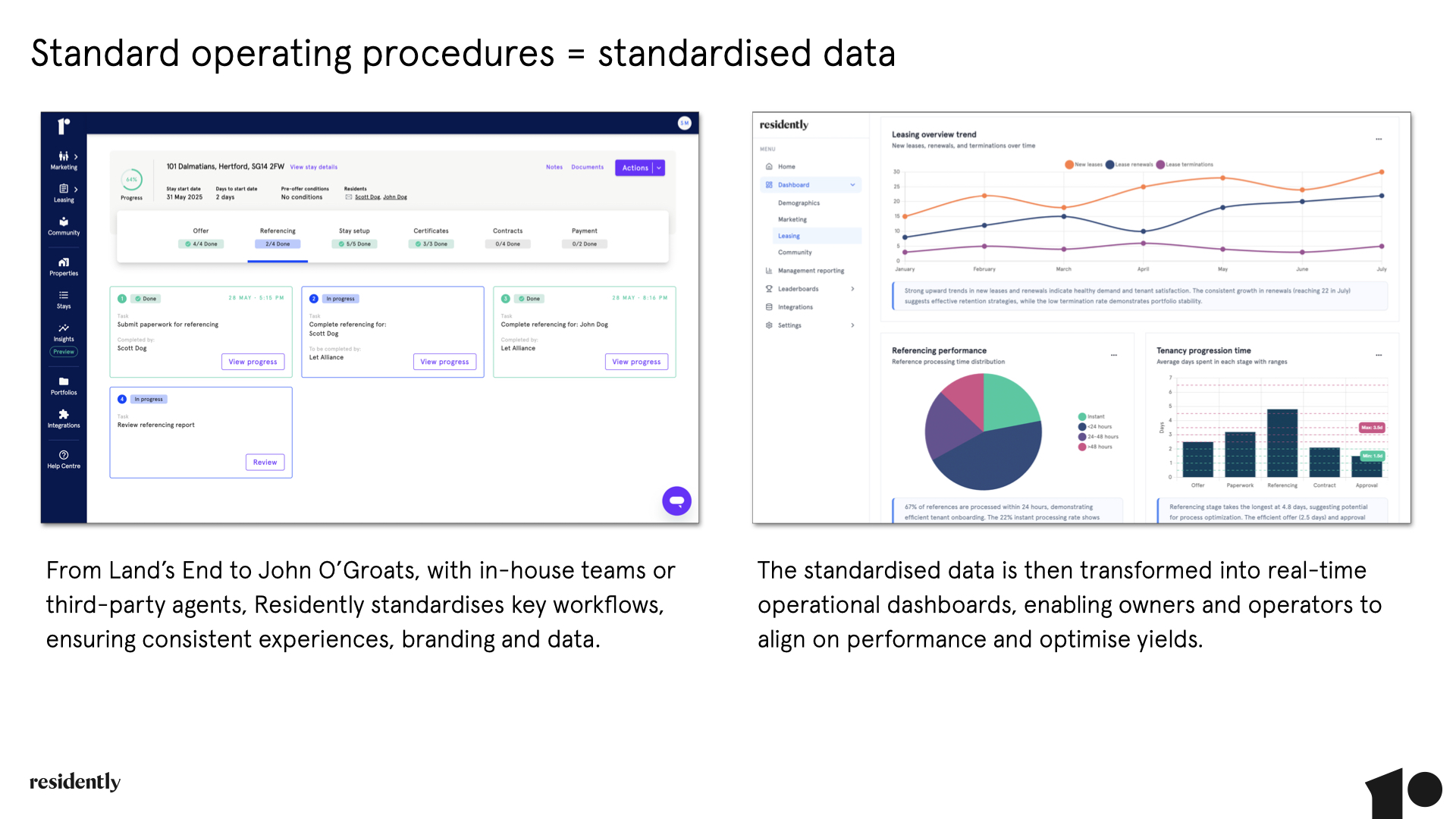
The reason reporting is broken is because the operational layer underneath it is fragmented. You cannot build a reliable single source of truth on top of inconsistent, siloed inputs. The only durable solution is to standardise the workflows that generate the data in the first place.
That is the principle behind Residently's Insights+.
Our rental operating system standardises how every workflow is executed — marketing, leasing, tenancy management, resident engagement, renewals — across every property, every team, and every geography. Because the process is consistent, the data it produces is consistent. And because it all flows through one connected platform, it is available in one place, in real time, to everyone who needs it.
Asset managers can benchmark occupancy, arrears, and operational outliers across their entire portfolio without making a single phone call. Investors can access transparent dashboards that translate day-to-day operational activity into the financial metrics that matter to them. Portfolio managers can align what their teams are doing on the ground with fund-level KPIs, without waiting for a monthly report that is already out of date by the time it lands.
This is what Insights+ delivers: not just better reporting, but structured, actionable intelligence that connects operational performance directly to asset value. At a 4–5% cap rate, every £1 of NOI improvement is worth £20–25 in asset value. The cost of not having visibility is not an administrative inconvenience — it is a capital risk.
Institutional capital has become extraordinarily sophisticated in how it evaluates, acquires, and structures real estate assets. The financial modelling, the due diligence, the covenant structuring — all of it reflects genuine expertise.
The operational technology has not kept pace. And the Knight Frank data is a clear signal that the sector knows it.
Owners and investors who are managing portfolios at institutional scale deserve tools that match their ambition. Not fragmented point solutions. Not legacy systems that export data into spreadsheets. Not operational models that require a phone call to find out how a building is performing.
The benchmark for what good looks like is a single, connected operating system that delivers real-time visibility across the entire portfolio — from individual maintenance ticket to fund-level return. That infrastructure exists. The question is whether the sector is ready to demand it.
Residently's rental operating system is live across 20,000+ units and 60+ institutional clients. Insights+ gives asset managers, portfolio managers, and investors a single source of truth across marketing, leasing, and resident engagement — in real time.