For decades, renting was treated as a series of short-term transactions. A resident moved in, paid rent, and moved out. Operations focused on administration rather than relationships. Experience was fragmented, reactive, and largely invisible at an asset and portfolio level. That model no longer works.

Yield compression, higher operating costs, and constrained capital mean institutional owners can no longer rely on rent growth alone to drive returns. At the same time, the renter profile has fundamentally changed. Families, professionals and long-term households now dominate demand, particularly across single-family and suburban BTR. These residents expect stability, service and a sense of belonging, not a temporary, high-friction experience.
Community management has therefore moved from a “nice to have” to a core operating discipline. Not as a soft branding exercise, but as a measurable driver of stabilisation, retention, NOI and ultimately asset value.
This is the institutional owner’s guide to doing community management properly, and at scale.
In today’s market, volatility is expensive. Every avoidable void, failed renewal or disengaged resident compounds operational drag. Retention, controllable voids and operating efficiency now matter as much as headline rents.
At the same time, the demographic reality of renting has shifted:
These residents are not “passing through”. They are choosing to rent long-term, and they behave more like customers of a hospitality or subscription brand than ‘tenants’ in a traditional letting model.
Community management, therefore, is not about event calendars or welcome packs. It is about building a long-term relationship that supports stabilisation, renewals and predictable income across the portfolio.
Most institutional owners recognise the importance of community, but few execute it effectively, and the reason is structural.
Traditional property management stacks were designed around accounting, not experience. The result is a patchwork of portals, inboxes, spreadsheets and point solutions:
For residents, this creates friction, uncertainty and disengagement. For property teams, it creates admin overload, lost context and inconsistent service. For asset managers and owners, it creates opacity, a lack of real-time visibility into what is actually happening on the ground.
Community cannot thrive in a fragmented system. Relationships require continuity, trust and consistency. Fragmentation breaks all three.
Institutional community management starts with a simple but profound shift in mindset: The tenancy is not a transaction. It is a lifecycle.
From first enquiry to renewal (and beyond), every interaction shapes resident behaviour:
To manage that lifecycle at scale, owners need a single operating system that connects residents, property teams, portfolio managers and investors around one source of truth.
This is where Residently was purpose-built to operate.
Residently is the only rental operating system designed specifically for institutional residential portfolios. We sit above legacy accounting systems, institutionalising the front end of operations — where experience, efficiency and value are created.
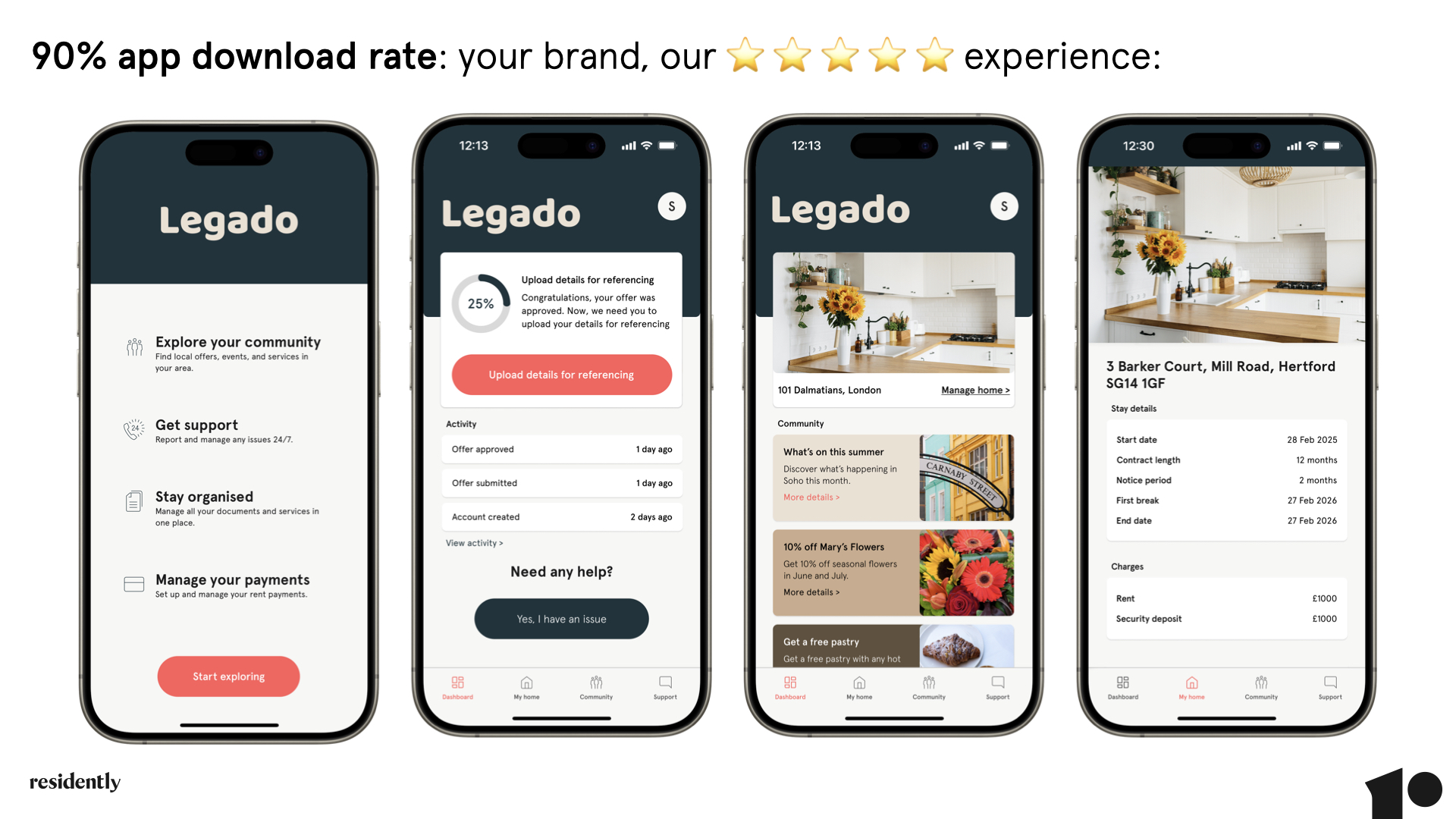
For residents, everything happens in one place:
This single, consistent, white-labelled app sets a clear expectation from day one: this is not a traditional rental experience.
The result is trust, confidence and engagement. Across our portfolios, we see a 90% resident app adoption rate — not because residents are forced to use it, but because it genuinely makes renting easier. That app becomes the foundation for community. Not a bolt-on, but the everyday interface through which the relationship is managed.
Community management fails when teams are overwhelmed by admin. Residently removes the friction that prevents good service from becoming consistent service:
Property managers spend less time firefighting and more time actually managing residents and communities. We consistently save 7+ hours of admin per tenancy, freeing teams to focus on high-value interactions that improve satisfaction and retention.
This operational clarity is what allows new residents to be “bedded in” quickly — a critical yet often overlooked factor in long-term engagement and likelihood of renewal.
True community management is not about sentiment alone. It is about outcomes.
Through the Residently app, operators can actively shape resident behaviour in line with fund-level objectives:
This is how community becomes commercial — aligning everyday engagement with measurable performance metrics.
Legacy systems tell you what happened weeks later. Residently tells you who your residents are, how they behave, and why performance is trending in real time.
Because our leasing and paperwork flows sit on the Residently front end, we capture first-hand demographic data at scale, including:
This data exists alongside live operational performance in Insights+ — our data platform.
The result is something institutional owners have historically lacked: connected insight.
This level of visibility enables owners to:
In fact, the need for this insight was born from risk management. Post-COVID, one institutional partner used Residently’s demographic data to assess exposure to furlough risk and essential vs non-essential employment. That capability is now central as the Renters Reform Bill and wider regulation increase scrutiny on resident outcomes.
Community management, done properly, is not just about engagement. It is about resilience.
Institutional owners do not need more point solutions. They need control, consistency and clarity across growing portfolios.
Residently enables:
This is how rental portfolios stabilise in volatile markets. This is how renewals improve, voids fall by up to 30%, and service justifies a rental premium. And at institutional cap rates, this is how community translates directly into asset value.
The shift from transactional renting to long-term relationships is already happening — driven by economics, demographics and resident expectations.
The question for institutional owners is not whether to invest in community management, but how to do it at scale, with discipline and measurable returns.
Residently was built for this moment. One platform. One source of truth. One relationship that’s managed across the full tenancy lifecycle.
Because in modern residential investing, operations are not back-office. They are the asset.